Tuesday, July 29, 2014

How To be More Productive in Your Personal and Professional Life


Isn't There More You Could Be Doing?

It seems that we're all busy people. We always have someplace to go, something to do, a phone call to make, etc. And yet, for all that hustle and bustle, we never seem to get caught up. We are never quite as productive as we'd like to be.

With that in mind, it makes sense to take stock of how we are spending our time, and look at things we can do to be more productive.


Quit Your Second Job: Turn Off the TV
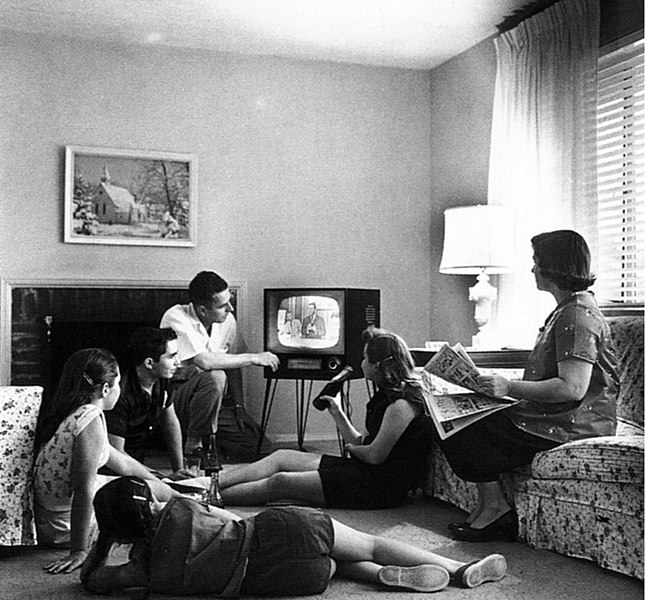
Most Americans have a second job and don’t even know it. It’s called watching TV. Believe it or not, the average American watches approximately 34 hours of television per week. 34!

That’s a lot of man-hours – practically enough to work full-time somewhere. (Now you know the reason I referred to it as a second job…) That’s why one of the first steps in being more productive – and I know it’s hard – is turning the television off. Right now, most Americans are like addicts; they have to get their television fix or they feel like they’ll go bananas. But trust me, after you turn it off and get used to having it off, you’ll be shocked by what you can get accomplished.

That said, I know most people won’t be able to shut television out completely. However, it’s an epidemic, much like obesity. Thus, you need to curb your appetite for television – take in fewer broadcast calories. I would suggest you try to limit yourself to a maximum of 10 hours of television per week. Thus, you need to pick the programs you absolutely must watch, and jettison the rest. (And with television now being a rare treat, you can justify watching your programs on a nice set.)


Make a List of Goals and Things You Want to Accomplish

Statistics have shown that people who write down their goals come a lot closer to achieving them than those who do not. Therefore, your productivity is likely to increase if you make a to-do list of things you want to accomplish.

In short, no matter what your goal is – whether it be losing weight, competing in a triathlon, or writing the great American novel – you stand a better chance of making it happen if you write it down.


Keep the list close – maybe in your wallet or purse – and review it a couple of times each week. And as you accomplish the things you’ve written down, check them off. (And maybe add some new objectives.) And the goals don’t all have to be lofty; they can be simple things, like baking a cake for a friend, finally getting around to cleaning out the garage, and so on. You’ll find that after you complete a couple of the items on your list, that feeling of accomplishment and success is something that you’ll want to experience again and again.

Exercise for Energy
Studies have shown that regular exercise not only increases your energy level but also fights fatigue. Wouldn’t you be more productive if you stayed energized? If you didn’t get tired very easily?

Thus, you should adopt a regular exercise regimen. It doesn’t matter if it’s lifting weights, riding a bike, walking or pilates. The important thing is to do some form of exercise. Moreover, after you make it part of your regular routine, you’ll soon find that you feel out of sorts if you somehow fail to exercise on a day when you were supposed to.

In retrospect, it can be fairly easy to become more productive. Cutting down on your television viewing will give you gobs of time. Making a to-do list will give objectives to shoot for. Finally, regular exercise can give you the energy to get the job done. In brief, this is a workable plan for becoming more productive. (And once you’re more productive you can turn your hand to other things you may be interested in.)


If you would like to be notified when I release new books, please subscribe to my mailing list here.

Tuesday, July 15, 2014

Television Shows I Can't Believe Were Greenlit!


I'm just going to put it out there: these are TV shows that I can't believe got a green light. I'm not trying to say that all - or even any - of these shows were bad. (In all honesty, I watched them all.) I'm just saying that I can't believe some studio honcho gave the thumbs up to them, because on paper I'd think they sounded wacko. That said, without further ado...


Bigfoot and Wildboy

Okay, this show always made me think that somebody wanted to make a Tarzan series, but with Tarzan being from the U.S. Since great apes are not indigenous to North America, and the boy-raised-by-wolves thing was being done on the show Lucan (read below), who did that leave? Bigfoot! Yes, Bigfoot gets to raise a kid!
https://www.youtube.com/watch?v=-NNb1pgQlQo
Set in the Pacific Northwest, Bigfoot and Wildboy is supposedly premised on the concept of Bigfoot finding a lost kid and raising him. (And raising him right – with morals and ethics and all that jazz. Pretty cool for a creature that couldn’t speak!) To be frank, I’ve always wondered what was going through the head of whoever said, “Yes” to this show. Of course, it was from Sid and Marty Krofft, who practically owned Saturday morning television back in the '70s. Those guys could get anything they wanted on television. (They never even bothered making pilot episodes; they just went in with sketches of what they wanted to do, and the bigwigs just seemed to always say, “Okay.”) Plus, I actually enjoyed the show, although some of it is laughable – especially the intro. Still, if the opportunity presents itself, you should check it out.


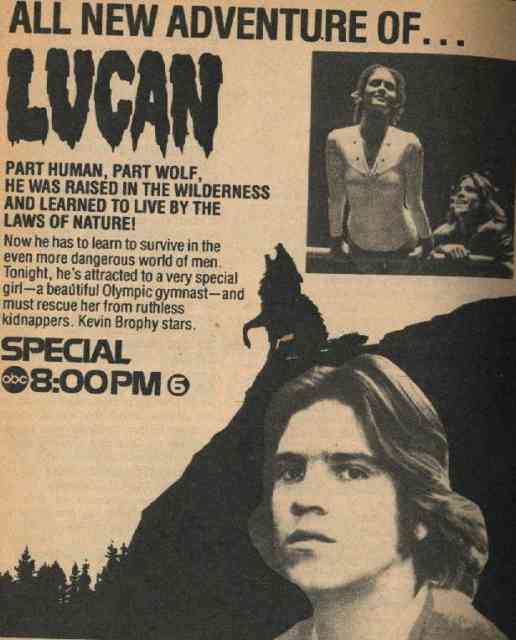
Lucan

This was a boy-raised-by-wolves adventure series that aired during prime time in the ’70s. The premise of Lucan centered on a boy found in the wilderness after having been raised by wolves the first 10 years of his life. He is brought back to “civilization” for study and indoctrination into society. Although feral at first, he gradually – over the course of the next 10 years – becomes civilized while living (and being studied) at a research institute.

Source: http://ctva.biz/US/Adventure/Lucan_ad.jpg
One of his doctors is basically a father-figure to him, and when it seems that Lucan is in danger he encourages the young man to leave and try to find his true identity. He becomes a David Banner (Incredible Hulk) wanderer type, going from place to place and helping people along the way. Lucan has certain wolf powers: his eyes turn red when he’s angry, and he can see and smell with the senses of a wolf.

Basically, this was The Jungle Book transplanted to America. (Notice how U.S. studios have to Americanize everything?) The show only lasted a season, but again it’s one of those that you wonder how it got the go-ahead in the ’70s disco era. (Hmmm, maybe if Lucan occasionally cut loose in a club in a white bell-bottom suit – or if they had the BeeGees write a theme song – the show would have lasted longer.)

Anyway, I’m probably making it sound worse than it was, because it memory serves it was actually an okay show. You can see the intro here.


Manimal

In Manimal, wealthy Jonathan Chase supposedly learned the secrets of shapshifting in deepest, darkest Africa while he was a boy. Now, he uses his abilities to help the police solve crimes.


To be honest, I thought this was a pretty cool series. I can only recall the guy shifting into one of three animals – a hawk (nice), a panther (cool) and a slow-moving snake (huh? What’s the purpose of that?). However, according to the promos, I think he was supposed to be able to change into any animal he wanted. (Of course, this was almost 30 years ago when the series aired, so maybe I just don’t remember.) Anyway, it’s another series that didn’t go the distance – but it was fun while it lasted!


The Man from Atlantis

Before he became a heartthrob on the mega-hit Dallas, Patrick Duffy was an amnesiac called Mark Harris, whom scientist believed to be from the lost city of Atlantis. He had webbed fingers and toes, and gills in addition to lungs so that he could breathe underwater.
To be frank, this was actually a neat series. I just can’t believe anyone in Hollywood was gutsy enough to get on board with it, because the premise was a little different. The lead character gets found in the ocean (I think he gets caught in a fishing net or something) and when they examine him they discover that he has all these marine attributes.

Hmmm…  Now that I think about it, this would probably make a great feature film.  (Of course, I hear an Aquaman film is already in the works, but that hasn't kept Hollywood from releasing similarly-themed movies before - eg, in a few weeks I think we'll get the second "Hercules" movie of 2014.)


Regardless of whether you think they were good or bad, I'm really happy to see that shows like this were actually being made.  It showed (or at least makes me think) that someone in Hollywood had an imagination.


Friday, July 4, 2014

Book Review: Logan's Run

I don't think it comes as a big surprise to anyone that I'm huge sci-fi/fantasy fan.  Therefore, I'm occasionally asked what's my favorite book in that arena. But like most avid readers, there's no single novel I could point to and say with absolute certainty that it's my all-time favorite (and that goes for any genre).  However, there is one book that I always thought was an incredible read: Logan's Run, by William F. Nolan and George Clayton Johnson.

Let me be perfectly frank: the book completely blew my mind.  I've never read anything like it before or since.

First of all - before the story itself even begins - there was the incredible dedication page.  On it, the authors list a host of individuals, characters, and even other books, dedicating the novel to everyone from Frankenstein and Jiminy Cricket to the Marx Brothers and The Most Dangerous Game.  I interpret this as the authors thanking those people (factual and fictional) and stories that inspired them.  Like the rest of the book, I've never come across anything else like it.

The novel itself was originally published in 1967 and takes place in a future when human society seems to have achieved Utopia.  Everyone is young and beautiful.  (And if you don't like your appearance, you can easily change it.) You can have anything you want, go anywhere you want, do anything you want. In short, it's a sex-drugs-and-rock-n-roll culture where personal bliss can be obtained either naturally or artificially. There's only one catch: you have to die at age 21.    

In the world of Logan's Run, everyone has a crystal flower embedded in their palm at birth that tracks their age: up until age 7, the cyrstal is yellow.  From 7-14, it's blue.  After age 14, it becomes red.

On your 21st birthday, the crystal starts to flash, alternating between it's normal red color and black.  This means that you are on "Lastday" and have twenty-four hours before reporting for mandatory "Sleep." After twenty-four hours, the crystal goes permanently dark.  If you haven't reported for Sleep by that point, you are said to be "on Black" and are considered the worst kind of criminal - a "Runner." Agents of the Deep Sleep organization - popularly known as "Sandmen" - rigorously enforce the law by hunting down and mercilessly killing all Runners, with no exceptions. 

Logan is a Sandman - one of the best. But when his own crystal starts to blink he has a critical decision to make. By almost blind luck, he stumbles across information about a legendary place called Sanctuary, where people can allegedly live out their lives in peace and die of old age. Eventually he teams up with another Runner named Jessica, and they decide to seek out Sanctuary together.

In terms of characterization, Jessica is a fairly straightforward individual whose motivations are easy to understand: she wants to live, plain and simple. Logan, on the other hand, is clearly a tortured soul.  He's dedicated and devoted everything he is to being a Sandman and upholding the law, but at the same time he clearly has reverence for his own life.  For much of the novel - as he and Jessica traverse an exotically dangerous futuristic landscape that includes everything from undersea cities to arctic prisons to killer cyborgs - it's not entirely clear whether Logan wants to find Sanctuary in order to save himself...or destroy it.  Further complicating matters is the fact that the two Runners are being relentlessly pursued by Logan's friend and colleague, Francis (whom even Logan admits is probably the most competent Sandman alive).

Of course, the novel can be seen as an allegory of contemporary society in a lot of ways.  In the book, almost nobody cares or seems to understand that they're living in an oppressive culture.  Few are attentive enough to see that they are under the control of a dystopian regime until they're on Lastday, at which point it's too late. (How much societal change can you realistically effectuate in 24 hours?)  

Likewise, in the real world, people often don't realize that they're part of an oppressive society until they experience that oppression themselves.  Even worse, in Logan's Run there are constant signs that the current system - which is run by a gigantic computer known as the Thinker - is corrupt (in the sense of decaying, as opposed to being dishonest) and breaking down, but  no one seems willing to do anything about it.

Now that it's pushing up on 50 years of age, you don't hear a lot about Logan's Run these days. However, the novel was popular enough to have spawned two sequels, a major motion picture (which I personally consider a sci-fi classic), a television series, a comic, graphic novels and other adaptations. A remake of the movie has supposedly been in development hell for years, but hopefully it will eventually get the green light.  (On a side note, I penned my own version of a Logan's Run screenplay years ago, but that's a story unto itself.)

In essence, the novel is a depiction of a world that had to deal with an ever-expanding population in the face of limited resources.  The result is a society where mandatory death is the only way to ensure that everyone has at least a chance at life - even if it's greatly curtailed. Thus, one of the fascinating things about the novel, I think, is the question that it silently proposes: Would you be willing to die at a designated time in exchange for a life of constant pleasure? Is the trade-off worth it - no worries in exchange for cashing in your chips on a date that you can circle on the calendar? 

And, in a completely hedonistic society, do you eventually tire of it all? Also, what motivates you to do anything when almost everything you want is at your fingertips?  (I  think this is the issue that some people see in the concept of inherited wealth. I believe it was Warren Buffett who said that you should leave your kids enough money so that they could do anything, but not enough so that they can do nothing.)

In short, Logan's Run is an absolutely fantastic piece of science fiction and probably the best dystopian novel I've ever read.  It can certainly be viewed as a representation of some of the problems in the modern-day world, but I think you'll get the most enjoyment out of it by treating it as the exciting, action-packed yarn the writers seemed to have wanted it to be.


If you would like to be notified when I release new books, please subscribe to my mailing list here.
  

Sunday, June 15, 2014

Update on eBook Sales: 25,000 Sold

So the other day I crossed the 25,000 mark in ebook sales. It's not anything that crept up on me unannounced or unexpected; it was a milestone that I'd been looking forward to for a while.  (I had actually hoped that I might cross it within the first year of publishing my fiction, but I'll take it at 13-and-a-half months.) In fact, I've had my eye on that figure since at least October of last year, when I crossed the 10K ebook mark (which you can read about here if you're so inclined).

Looking back over the past year, there's no doubt that GOD has blessed me tremendously in terms of my writing. First of all, readers have just been absolutely amazing; there's no way I could put into words how much support and encouragement they've given me. I was also fortunate enough to connect very early on with other professionals who helped improve what I had to offer, like my editor (Faith Williams) and my cover artist (Isikol).

Of course, it's often hard to put something like sales into perspective.  On the one hand, there are people who have been at this a lot longer than I have and who would kill for my sales. On the other hand, there are those for whom my 25K in sales nothing - they do that every month. So is 25K annually - or any particular level of sales - good or bad? Personally, I'm not sure if there's a single answer to that, because - in my mind - the final arbiter of that decision has to be the author and what his/her goals are.

Basically, you as the author have to decide what level of sales constitutes success.  For some, it may be no sales; they have a story to tell, and they're not concerned with whether it makes money. For others, it may be earning enough to pay a few bills. Somebody else might say it has to be enough for them to quit their day job.

For me, I think I was initially one of those people who just felt that I had stories to tell (although I wasn't particularly adverse to earning a little moolah along the way). Thus, I didn't really have a set goal in mind with respect to how I realistically expected my books to perform. That said, I believe there were other authors out there whose sales trajectories I was hoping to mimic. (Frankly speaking, I was inspired by those who achieved success, which is a large reason why I'm sharing my numbers here - assuming others find anything impressive about how I've done thus far.) I also kept my fingers crossed that, as I wrote more books, my sales would gradually increase over time.

As to the how the numbers have actually shaken out, here's what I come up with:

     1) I sold 10,000 ebooks within the first six months.  That works out to an average of about 1,667 books per month.

     2)  Over the next 7.5 months, I sold 15,000 ebooks, which averages out to 2000 books per month.

(It goes without saying that there are a lot of ways to break down the numbers. In this instance, I focused on divvying them up based on what I considered significant milestones: 10K, then 25K.)  The good news, obviously, is that my average monthly sales seem to be increasing over time as I publish more books. But, as almost any indie author will tell you, those numbers will start a steady, gradual decline unless you keep putting out new material. Hence, the perpetual (and rock-solid) advice that almost everyone gives: one of the best things you can do for your career as an author is to write the next book.

Bearing that in mind, I am currently hard at work on my next novel. Self-publishing has been an absolute thrill-ride thus far, and I'm looking forward to it [hopefully] continuing well into the future.


If you would like to be notified when I release new books, please subscribe to my mailing list here.

Sunday, June 8, 2014

Editor Interview: Faith Williams of The Atwater Group

Today I'm very excited to be interviewing Faith Williams of The Atwater Group.  Faith is an accomplished proofreader and copyeditor who has worked on several bestsellers. Needless to say, she stays fairly busy, so scoring this interview was something of a coup.

Please tell us a little about yourself.  
I grew up in a small town (population less than 5,000 when I was a kid).  My town was so small we didn’t have our own high school, so I went to a private Catholic high school (even though I’m not Catholic) about thirty minutes away from my house. I have two older brothers, but we also took in foster kids.  Some stayed a few days; others stayed for years. I met my future husband when I was working in a bookstore and he came in to order a copy of Mr. Boston’s Bartending Guide.  (My co-worker insisted on being the one who called him when it came in. I was all like, “Whatever.”)

How would you characterize the type of work you do - editing, proofreading, copyediting…what? 
Most of the work I do is light copy-editing, but I also do proofreading.  I like copyediting because I can play with the words more than I do in proofing, but proofing is quicker! J

How did you get into editing and how long have you been doing it?
I’ve been proofreading and copyediting since 2011, ever since I left my position as an administrative assistant.  My first paying gig was for a Chinese university’s academic club: the students were applying for college programs in the US and needed a bit of fine-tuning on their essays.  It was challenging, especially when the papers explained a scientific process or experiment that demonstrated their skills but I enjoyed reading their personal statements.  My favorite description of a student:  Moreover, Xidi is a Sunshine girl as well. She always wears a warm smile and makes people comfortable. I found that her classmates always went to her and asked her questions during the break time and she always answered them patiently. The students all speak highly of her because of her kindness.

Are most of your clients self-published or traditionally published, and does the distinction matter to most editors? 
I’d say most of my clients are self-publishing, or at least a hybrid author. I guess it depends on the editor whether it matters or not. I’ve found that comments from other editors on self-publishers range from very positive (authors are willing to listen and obey accept my suggestions) to very negative (I’d never work for anyone who couldn’t make it through a publishing house). I made a conscious effort to work with self-publishing authors, so I’m fine with it.  Plus, I get to see some great manuscripts that don’t fit neatly into a publisher’s preconceived notion of what a “good” book is or don’t fit into a specific genre.

What types of books make up the bulk of your work? 
Well, it’s definitely fiction, that’s for sure.  It seems to go in spurts: some weeks, I am reading romance and chick-lit; some weeks, it’s science fiction and fantasy everywhere! I am starting to see an uptick in shorter manuscripts, in the 20-25K range but I still can count on a few authors to clock in over 120K!

Do you do any leisure reading, and if so, what’s your favorite genre? 
“Leisure?”  I need to consult my dictionary to see what that is…oh, yes, freedom or spare time provided by the cessation of activities.  Hmmm…I vaguely remember leisure.  Seriously, though, I do get breaks from reading to well, read.  Interestingly enough, I typically get my recommendations from my authors posting on Facebook or Twitter on people they read. I don’t tend to read the big names (typically traditionally published authors or some of the bigger indie authors) unless I’m re-reading something.  I just picked up Barbara Taylor Bradford’s Woman of Substance.  I’d read it as a teenager and now have it on my Kindle. I’d forgotten how much it made me cry, so I’m pacing myself through that one! My favorite genre—that’s like asking me to pick my favorite child (except I only have one kid, so maybe that’s not a good example!). I typically pick up romances, but I’m pretty happy with science fiction and fantasy.  My least favorite is, well, I guess I don’t have a least favorite in the fiction realm.

When you’re working on an author’s project, do you ever get a feeling like “This will be a bestseller!” or “This will be a dud”?  (And if so, how often are you right?) 
Some books really resonate with me personally, so I’d like to think they’d be bestsellers.  I’ve had several go on to the New York Times and USA Today Bestseller lists.  I would say there is one book that sticks in my mind as a complete dud (and no, it’s not one of yours, Kevin!).  It’s hard to say if I’m right or wrong on my personal barometer of what should be a success because I don’t get to see sales reports for my authors (I could look at Amazon rankings, but that changes every hour, it seems, so it hardly seems like a good use of my time!).  I hope that my authors succeed, in whatever way they define success: a traditional book publishing contract, 10 sales a week, or 100 sales a week.  

If you weren’t an editor what would you be doing? 
I’m not sure; this is really my dream job.  As I tell people, I get paid to read and tell people when they are wrong—what could be more perfect?  So maybe I’d be running a book blog…that might a close second as a dream job.

What are some of the more common problems you come across when editing? 
Each author seems to have their own quirks.  Some are real errors (like a misspelled word), but sometimes authors like things a certain way that doesn’t conform to the Chicago Manual of Style, which is the standard style for fiction.  There’s always the to/too/two and their/there/they’re types of errors that can trip anybody up; I also often see “common” phrases that are spelled the way they’ve been heard, not the way they should be spelled: could of is really could have or the phrase If you think X, then you have another thing coming is really If you think X, then you have another think coming.

Do you have an opinion on the things indie authors can do to sell more books? 
Write, write, write!  I think it’s a bit like acting in a way: you are in the public’s mind with each new project.  If you only write one book and then not write/publish for a year or more, you lose momentum.  The more you have to sell, the more you can sell.  As an indie author, it seems you have to do everything.  This double-edged sword means you have control, but also that you are in charge of writing, editing, cover design, formatting, and promotion.  You can hire out for some of those, but ultimately it’s your baby and your work out there.  It’s a balance between the writing time and the business side (marketing, promotion, etc.)—and you can’t ignore either of those things.

Have you ever had the urge to write a book yourself? Why or why not? 
As evidenced by my blog, I am not a writer by instinct.  I don’t have any characters in my head trying to get out and tell their story.  I do better improving a story rather than creating one.

Before we close, is there anything in general you’d like to share with our readers? 
If you are a writer, thank you for your stories.  Even if you only sell one copy a month (and it’s to your long-lost cousin who just found you on Facebook), you have created something unique and wonderful.  Don’t get discouraged.  If you are a writer, write.  Don’t worry about the “success” of others; don’t judge your journey with theirs. 

If you are a reader, write a review or write to the author to tell them how much you enjoyed the book.  A nice three-sentence email can make an author’s day!


And for those who may be interested in your services, how can you be reached? 
My website is www.theatwatergroup.com.  My blog is http://theatwatergroup.blogspot.com/.  I have a Facebook page (www.facebook.com/TAGProofreading) and you can follow me on Twitter (www.twitter.com/FaithProofing).  But be prepared: it can be a few months before I have availability on the schedule, so plan ahead!

My thanks to Faith for taking time out of her busy schedule for this interview. As I've said many times on this blog, it's practically impossible to edit your own work (a lesson I learned very early on); you really do need expert help.  Thus, I'd encourage any and all indie writers to have your work professionally edited.  Your readers - and you, yourself - deserve nothing less.

If you would like to be notified when I release new books, please subscribe to my mailing list here.

Tuesday, June 3, 2014

New Book Release: Warden Series Boxed Set (Books 1 - 3)

Finishing the third book in my Warden series felt great for a number of reasons - not the least of which is that I can now release the first Warden Series Boxed Set.


As with the boxed set of my Kid Sensation Series, it still feels weird to me that I've written enough books to be able to bundle them together like this. I mean seriously, just a little over a year ago - before I started publishing my two series - who would have thunk it?

Moreover, last year at this time, it felt odd to me to look at my Amazon Author Page and see two books listed. Seeing nine of them now (including the two boxed sets) is something that I still have a tough time wrapping my mind around.

Of course, it goes without saying that I'm loving every minute of being an author.  Even more, I feel blessed that readers seem to be finding and enjoying my work. Hopefully that's something that will continue for a long time to come. For now, however, I've got to get back to grinding on the next book.


***FYI:  The Warden series is available for only $4.99 - a steep discount to the cost of buying the three books separately.  (In fact, that's a discount even if you bought the first book at the price of $2.99!)


If you would like to be notified when I release new books, please subscribe to my mailing list here.

Wednesday, May 21, 2014

Removing "Said" From Your Vocabulary as an Author


A few days ago, I was talking to another author who is in the process of writing her first book.  She mentioned that she was having a problem with dialogue - in essence, she couldn't get away from using the word "said":

He said...
She said...
Barb said...

And so on, ad nauseum. All conversation seemed to require the use of "said."

I understood her dilemma, but - as I informed her - in truth there are dozens of words that can be used in place of said:

Commented
Replied
Responded
Stated 
Mentioned
Remarked


And if you need to see examples:

"You dyed your hair," Bob observed.
"Your dog is sick," the vet noted.
"I will hate her for as long as I live," David solemnly declared.


In fact, it's not even required that you use an indicator of speech:

Bob arched an eyebrow skeptically. "Oh, really?"
Angie stared at Muffin, then turned to James with a look of incredulity. "What the hell did you do to my dog??!!"


Basically, you don't have to use a word that specifically indicates that speech is occurring - the quotation marks will do that. (That's essentially the point of having them - to denote dialogue or speech of some sort.) You just simply have to make it clear who the speaker is. As long as you've got that base covered, you're home free with respect to this issue.


If you would like to be notified when I release new books, please subscribe to my mailing list here.

Total Pageviews